Make Proposal.. Close Deal!

Therapists often ask, “How do I close the deal with a client workplace?”

Several important tactics here.

First, always entitle your proposal “Budget Proposal” to reflect your concern about keeping their costs well controlled.  Sensitive terminology has value.

Second, unless this is a very small workplace where your program can be completed in 1-2-3 class sessions, always initially propose a “Pilot Project” that offers to perform a small demonstration project for one smaller work area where they are having significant MSD issues, so they can assess the value of your program in a small-scale purchase (no, don’t do this for free). This may simply be a one demonstration class for them to watch (ask them to stack the class with employees and supervisors who are most likely to be sceptical of your program, so you can impress them.  This works well.)

Never give them a company-wide proposal that costs many thousands of $$, as this will result in an avalanche of objections, requests for bids from competitors, and endless comittee presentations.  You may give them such a proposal AFTER you have greatly impressed them with a demonstration pilot project, as they are already “sold” on your program.

Another starting point is for them to hire you just to perform and on-site MSD-Ergo Risks Assessment, to identify the scope and severity of their MSD risks.  Let that teach them what are their issues and how you can address them.  We will cover this task elsewhere on the blog.  It also allows you and them to prioritize where and how to proceed with training.

The general strategy is to proceed in a series of small steps, keeping progression through the facility a managable gradual process with regards to cost and logistics.  Clients appreciate this … and it allows you to get work going sooner and proceed completely.

As we said elsewhere… do not focus on the large employers in your area.  The bigger the company, the slower the progress toward actually billed work being done.  Bureaucracy!   We focus on employers with 25-300 employees, because it is easier to work directly with the person who has the actual budget authority to hire you.  Decisions are made much more quickly, often on the very day you present a proposal.  We prefer working with 10 smaller companies, over slogging along trying to get one big company to actually make a decision and actually schedule work.

Big companes are also notorious at making last-minute cancellations or postponing planned services the day before your scheduled on-site work.  That sticks you with weeks of no work.  That hurts your business.  Larger companies can be a business risk.  Go after smaller companies for quick intake and steady work. This has been key to our success.

Do not waste time negotiating your price!  Set your price and market your VALUE around that.  If you are find yourself defending and dickering price, you have failed to demonstrate the value of your services.  Good marketing is when you make a proposal and client says “yes, let’s schedule your program” and you haven’t even mentioned your fees.  That happens all the time for us (granted, we have marketed many hundreds of companies, but it does happen that way).  We almost never encounter any objection over the price of our services (all based on $300/hr onsite) (recently upgraded to $350/hr).

When client asks our cost early in our marketing meeting before we have completed our presentation, we initially tell them we first need to define what we do, so they can assess its value.  Once we have done that, we answer that we have prepared a “Budget Proposal” for them.  They will then be able to see the cost, after they have seen the value . Our budget is presented rather matter-of-factly, with our fees established at $300/hr.  (We do offer $250/hr for bulk pruchase deals, such as we have done with groups of companies organized into self-insurance pools, as an appreciation for the mutual loyalty we have established with them.)  We take the attitude (gently) that we don’t really negotiate our fees, out of fairness to all our clients.  Besides, if we prevent just one rotator cuff or back surgery for the workplace, they realize a huge “profit” in their investment in our program.

Stop your focus on price.  Make it a non-issue.

Here is PDF of one of our Marketing Guides
KillerMarketingTactics

MSD: Nutrient Pathway Disorder

If we assume MSD overuse disorders are NUTRIENT PATHWAY DISORDERS, then we can envision a range of effective prevention strategies.

Muscles contract, pulling on tendons, working across  joints, as discs and joints undergo weightbearing loads.  All these physical actions create pressure within these tissue… pressures that exceed the perfusion pressure of circulation feeding and cleansing these tissues.

If perfusion is blocked, tissue must work anaerobically (glucose and its precursors are stored in muscle, but oxygen must be continuously delivered during work). Work with inadequate O2 delivery burns way more glucose than work done aerobically, creating way way more metabolic wastes… which are now trapped in these tissue by blocked perfusion.  Metabolites accumulate to the point of creating inflammation.  The pain creates background muscle tension, increasing loads on muscles, tendons, joints.  Viscious cycle.

Recurring Inflammation increases damage-degeneration.  Accumulation of disorganized collagen and reduction in water content reduces elasticity, further increasing damage-degeneration.  These changes reduce work tolerance of hardwprking tissues.

Therefore… the key to preventing (and reversing) these cycles is to restore nutrient pathways to working tissues.  Improving ergonomics to reduce posture strain, repetitive motion, stressful movements, and tissue loading mechanics can reduce the degree of nutrient pathway obstruction (but certainly not eliminate the risks).

Imposing a variety of tasks (job rotation hourly, switch between computer mouse versus trackball hourly, switch between sit versus stand hourly) can redistribute the day’s physical demands across more tissues, thus reducing total loading per tissue, thus reducing physical demands to a non-toxic level.

Hourly micro-stretches that specifically target the hardest-working tissues can directly restore tissue perfusion throughout the workday.  This is key to protecting workers when ergonomics corrections or work task rotation-variety are not available options.  See our essay on micro-stretching.

None of these interventions will occur without everyone in the workplace being educated, not just on WHAT to do, but WHY to do it.  This will motivate everyone to commit to doing what is good to maintain and improve tissue perfusion.  Why will they do it?  A hard day’s work creates fatigue, discomfort, pain.  People don’t want that.  If we explain these tactics will reduce their suffering, people try them, feel better, and commit to keeping up taking care of themselves.  At least that is what we have seen at the last 600 workplaces we have delivered this program.

The “E’s” of MSD Elimination… Ergonomics, Exposure-reduction, Exercises, Education.


training-certification to do this work?

Many PTs ask if they need to undergo special “certification” training to do this work.  NO.  There are plenty of providers out there who will sell you a Certification course; I used to be one of them.  But it is not necessary to be “officially” certified.  There is no “official” certification as a legal entity.  Certification is a private label you purchase from a cont ed provider.  Some certifications require 30 days of training; yet, other is just a weekend course.  See the problem?

Your PT-OT education, more than any other profession, gives you the knowledge base to excel at this MSD prevention.  If someone asks for “certification” show them your PT license!

Of course it is critical to build your skills and continually seek good cont ed on this. Strive to be, and stay, the best.  But you will quickly realize the underlying knowledge base that makes you good at this… you already possess as a PT!   MSD Prevention Consulting uses the most basic of entry level PT musculoskeletal knowledge base.  You already know the effects of forward head posture, prolonged sitting, lumbar flexion, pathomechanics of HNP and DDD.  You already know how a patient develops neck strain, rotator cuff injury, tennis elbow, golfers elbow, CTS… right?

I state this boldly… Nobody has more professional education on workplace MSD pathomechanics than the PT-OT… NOBODY.   Most MDs will agree.  Of course there are inadequate PTs out there, just like any other profession.  But as a group PT-OTs are the MOST competent and qualified.  Even compared with engineers trained in ergonomics?  Ergonomics design engineers are trained in the engineering side of this, working on the assumption that MSD comes from ergonomically improper job design, and that correcting job design makes MSD go away.  Not quite.  Ergonomics is a PART of the MSD picture, but certainly not the whole picture.  Most MSD comes from worker behavior, not poor job design.  The engineering based ergonomists generally do not have the knowledge base to address MSD disease processes outside of ergonomics… such as posture habits, flexibility deficits, core instabilities, fitness-for-work deficits, body mechanics skills.  And most design engineers do not have a fraction of the medical-orthopedic training of the PT-OT.

We are simply re-packaging what we do with individual patients every day, into a delivery to groups of workers at the workplace… education and self-care tactics.

SO… how and where do you build your specialty skills?  There are plenty of cont ed providers, but beware of those demanding a long costly drawn-out path to their ceetification.  They offer great information, but keep it in perspective.  What you will come to realize is you already have the knowledge base, but need to focus it and develop a structure for using it.  What you are actually building is CONFIDENCE, more than competence.  And a delivery structure-protocol to follow.

The most simple, least costly, most targeted cont ed starting point resources…

  1.  Educata hosts my self-study online course as a basic but very practical starting point with info that you can immediately put to work.Lauren’s Educata course “MSD Prevention & Ergonomics” at www.educata.com
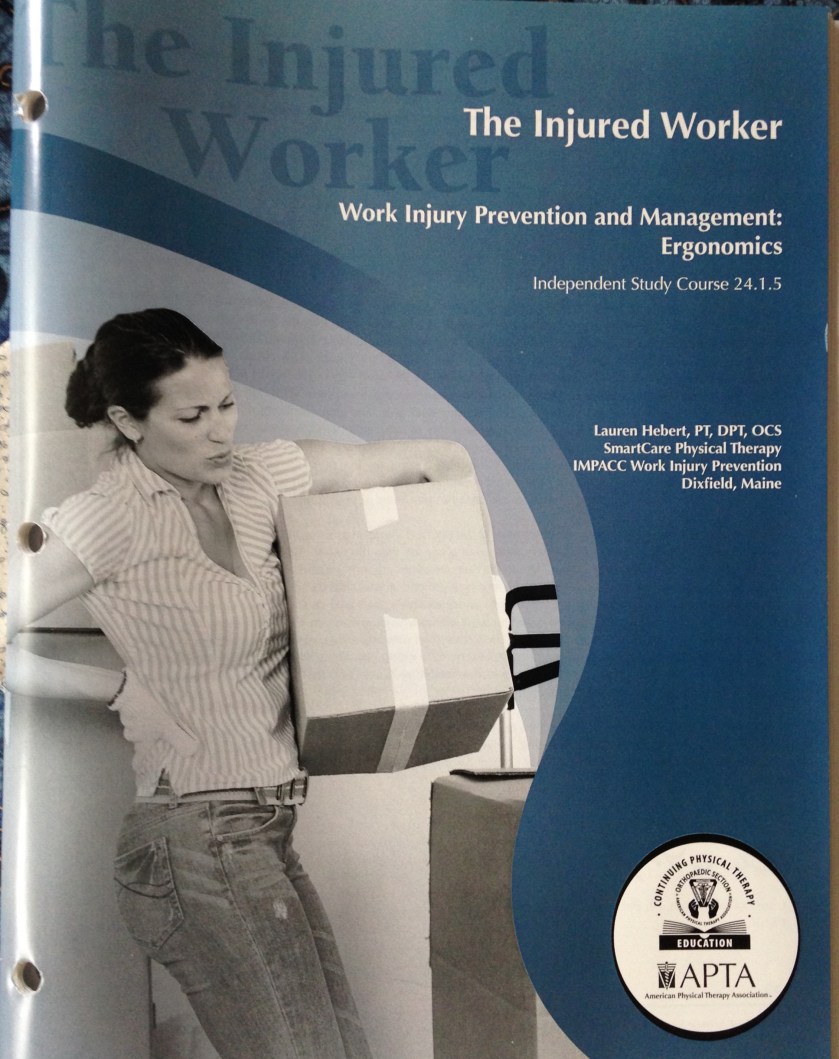
  2. APTA Orthopaedic Section has a great self-study program “The Injured Worker” with several components to help you build a comprehensive work injury consulting practice.  I authored the component on MSD Prevention & Ergonomics.  No, I don’t get a royalty for referring you.  This course covers roles, responsibilities, and opportunities for the physical therapist in providing services to industry. Wellness, injury prevention, post-employment screening, functional capacity evaluation, and legal considerations are covered by experienced authors working in industry.link here..http://orthoptlearn.org/doi/book/10.17832/isc.2014.24.1?code=ortho-site#/doi/book/10.17832/isc.2014.24.1

    course “The Injured Worker”

  3. Send me an email at LHbertpt@prexar.com and I will send you a folder of lots of materials I use as handouts to PT-OTs studying this topic.  And, of course, explore all the blog posts on this site.
  4. Those who obtain a copy of my Workplace Consulting Practice package will find it to be a comprehensive self-study process that guides the PT-OT to build their own Consulting Practice by replicating what I have been doing with mine.
  5. See blog page “Resources” for more

FMI… Lhebertpt@prexar.com

Preview of MSD School Presentation

Here is a PDF file of our complete MSD SCHOOL, the entire content and teaching format.  This example is our OFFICE ERGONOMICS SCHOOL version.

This PDF is easy for you to preview quickly, but in real-life the employee class is a two-hr training session teaching personal ergonomics skills, self-care of the working & aging musculo-skeletal system. The maufacturing version MSD SCHOOL is similar, but each version and each workplace gets a presentation customized to that workplace/risks.

When client asks if we can shorten the presentation, our answer is a simple courteous “no”. I explain the program used to be 4 hours, but has been heavily re-worked to get it down to 2 hrs. If we reduce it any further, we would be eliminating critical information, which would reduce the effectiveness of the program. And we will not provide programs that are ineffective. Every company has a tough logistical challenge to schedule this training. We understand that. But so far we have had more than 600 workplaces successfully make that happen.

This is a big PDF of a powerpoint presentation so it will take a little while to load… BUT it is so worth the wait!

computer2017 copy

Those PT provider “networks”

This site focuses on Workplace on-site MSD prevention consulting.  HOWEVER, many of us also have clinic practices.  And many of us encounter various Worker Comp PT provider networks.

I am not going to even try to be “nice” on this topic.  These networks are ripping off PT !

A network contacts you to inform you that, in order for you to access Worker Comp patients, you must contract through them, to coordinate care.  Rip-off.  What they are actually doing is demanding that they purchase your patient care services at a wholesale discounted rate… then they sell those services to the insurance payer at a retail rate.  It sure resmbles a kickback.   You must agree to deep discounted payment rates to access patients.  They then re-sell your billing at higher rate.   They also severely restrict the number of PT sessions you may provide, plus tons of paperwork, telephone hassles, and nonpayment of your billing.  Prostitution of PT?

These networks are so profitable, they are being bought and sold among investment companies.  Most of the PT worker comp networks are now owned by a European investment firm.  PT billing is now a commodity to be traded among investors. Some networks are actually owned by the insurance company itself, to force PT fee discounts and hassle you to shorten and compromise your care.

If one of them gets you to sign up with them, they then sub-contract that deal to the other networks (for a piece of the action) (networks collude with each other for a piece of your pie).  Thus, one obscure minor insurance network eventually infects all of your insurance payers.  And trying to cancel that bad contract is all but impossible.  The end result is your eventual bankruptcy when all your payers are now paying you below your cost of providing care.

Here in Maine, we PTs actually convinced our Worker Comp Board to severely restrict these networks, preventing PTs from being required to join these networks.  We now have no Worker Comp requirement for MD referral (direct access PT care of injured workers without MD referral), plus employees are allowed to select their PT of their own choice.  Workplaces and workers can both designate their favorite preferred PT provider.

Moral of the story… if you want to preserve the PT profession, and your practice… avoid bad network provider contracts.  Have a very good PT lawyer (such as Gwen Simons, JD, PT … gwen@simonsassociateslaw.com) screen network contract proposals to identify potential traps and ripoffs.   Yes, she is both a lawyer and a PT!

Many clinics absolutely REFUSE any network offers-demands.  When a network says you are required to go through them to access injured workers for your clinic… they are often LYING.

UPDATE on who are some of the Worker Comp PT networks… Align Networks merged with Universal SmartComp, and then acquired One Call Care Mgt (described as a ‘cost containment’company)… while Apax acquired Network Synergy, then acquired GenX…  all managed by the UK investment group Apax Partners.

Others include Coventry, Optum, MedRisk, MultiPlan, ASH Network, OrthoNet.

See how PT and our patients have become a commodity to be traded?    And where do these investors gain their profits?  They skim it off YOUR billings…. when you agree to accept their discounts and thier prior authorization ripoffs.  Some take up to 50% of your revenues.while severely liiting sessions and procedures and treatment time.

THIS IS WHY DPT SALARIES ARE SO POOR, DESPITE A DOCTORATE LEVEL EDUCATION!   THIS IS WHY PT CLINICS AROUND THE COUNTRY ARE DOWNSIZING OR CLOSING.  THIS IS WHY STAFF PT’S ARE PUSHED TO SEE TOO MANY PATIENTS PER DAY.

They re crushing PT practice… and so many PTs are allowing it to happen.   Someone said that PT practice has become “groveling in the dirt for pennies.”


Ergonomics Problem-Solving

This post will evolve rather continuously over time, as there is a wealth of tactics we can share for you to consider.  We will try to section this per body part.

Also be aware that you cannot ELIMINATE ergo hazards; you can only DILUTE the severity of the ergo hazards somewhat, and that is often enough.

Also, the greatest source of ergo suggestions is among the workers doing the work!  Just ask them.  Our job then becomes one of inviting, validating, communicating employee suggestions… so common.

And when ergo hazards cannot be adequately improved, we fall back to job task rotation (to reduce hazard EXPOSURE TIME) and specific targeted MICRO-STRETCH that match and reverse the effects of the hazards, by restoring blood supply to loaded tissues.

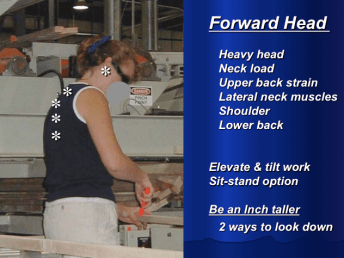
1. NECK and Thoracic Outlet-Inlet (PROXIMAL risk factors)… sustained sitting, sustained standing, forward head posture habits, staring at the computer screen , prolonged driving… TACTICS:  Have an adjustable chair.  It does not matter how it is fitted (contrary to the obsessions of some ergonomists who seek to impose perfect posture).  Posture VARIETY is far more important than posture perfection. Posture stresses at the neck-shoulder girdle contribute mightily to risks of developing MSDs thorughout upper extremity.  Reptitive motion risks at hand become less risky when neck posture stresses are reduced.

It is the TIME spent in one posture that is more critical than awkward posture. Key to seating is to CHANGE seat fit often, even if only to change seat height 2″ every half hour.  Better yet, use Vari-Desk to allow worker to switch between sit vs stand often (sit-to-stand option is very effective). The key is POSTURE VARIETY !

FHP.png

Motivation training to BE AN INCH TALLER to correct a posture habit.  MSD School training should teach WHY as well as how, to motivate compliance, by showing them all the nasty effects of forward head and sitting.  MICRO-STRETCHES at scaleni and chin-tuck axial extension stretches.

2. Seek UPPER EXTREMITY SUPPORT on padded desk surface to reduce UE loading at neck-thoracic outlet.  Place desktop computer in corner if available for more UE surface area.  Simply push keyboard in on desk and pad surface in front of it.  BEST option ismon a corner-desk setup (pic below) where keyboad-monitor place innthencorner, thus providing full bilateral forearm support on the adjacent desks.

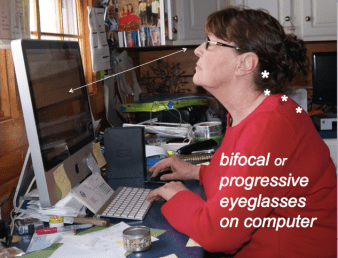
3. And avoid BIFOCAL eyeglasses on computer work (requires excessive flex at upper thor with secondary hyperextend head on neck… severe FHP).  Switch to single-vision reading glasses set for a slightly longer focus distance than used for book reading (slightly lower diopter). This is a very coomon risk, usually overlooked.

bifocal.png

4. SHOULDER reaching… Seek to at least mildly reduce HEIGHT reached, horizontal DISTANCE reached, TIME spent reaching, REPETITION of reach, LOAD in hands when reaching.  Move reach closer, or mover worker closer. An inch or two less high or less far can be critical.  Use CODMAN exercise often when reaching is unavoidable.

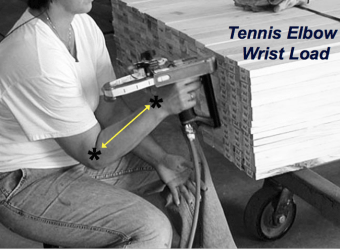
5. TENNIS ELBOW risks… comes from loads in hand held across wrist, especially with forearm pronated or neutral (eg, just holding a cup of coffee) (extensor carpi radialis).  Seek to reduce load, duration, repetition.   TE stretch to wrist and digit extensors.

Screen Shot 2017-03-19 at 8.33.00 PM.png

6. GOLFER’S ELBOW RISKS… Pronator teres load, also cubital tunnel risks… Grip (forceful, repeated, prolonged): wrist loading in supinated position (loading pronator).  Again, seek to reduce these loading factors, even if only mildly.  In example pictured, employer was able to replace this with lighter-weight power driver.  Forearm flexor group stretch done supinated.

Screen Shot 2017-03-19 at 8.33.24 PM.png

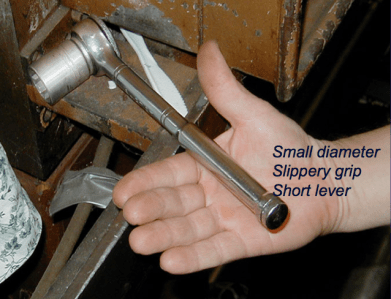
7. GRIP that is forceful, or prolonged (even light but prolonged), or repeated.. also loads carpal tunnel; risk based on grip force, diameter, duration, repetition, contact traction (slippery), vibration.

Screen Shot 2017-03-19 at 8.34.44 PM.png

These are boxed heavy doors & windows, boxes fitted with ergonomically improved grip handles for lifting-moving these heavy loads.

Screen Shot 2017-03-19 at 8.34.30 PM.png

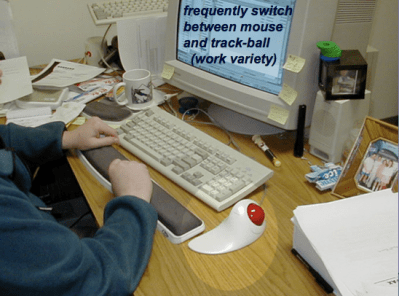
Mouse use risks Golfer’s Elbow, while trackball use risks Tennis Elbow… So, the best optionnis to use each of these, switching between them every1-2 hrs.  Posture-mvt variety reduces MSD risk… such as frequently (hourly) switching between mouse versus trackball, or flip keyboard legs (rear corners) in versus out to create slight changes in wrist posture, for wrist posture variety.  “Correct Posture” (whatever that may be) is a risk when it is sustained.  Postre Variety is far more healthy than posture perfection!

Screen Shot 2017-03-20 at 9.08.06 PM.png

more to come…

8. AWKWARD WORK POSITIONS THAT ARE UNAVOIDABLE… when awkward stressful prolonged posture is unavoidable, one must frequently stop to stretch out of that position to restore blood supply to stressed structures.  These workes need to “listen” to thier body formemerging discomfort, which should alert them to the need to STOP & STRETCH out that awkward posture.  If they are bent forward and to the left, then they shouldmstretch backward and then to the right to counter the work posture strain.  This is simple and effective… once employees are trained in this.  This is one example where very specific workplace stretches are critical (and often the ONLY employee protection tactic available).

IMG_1160

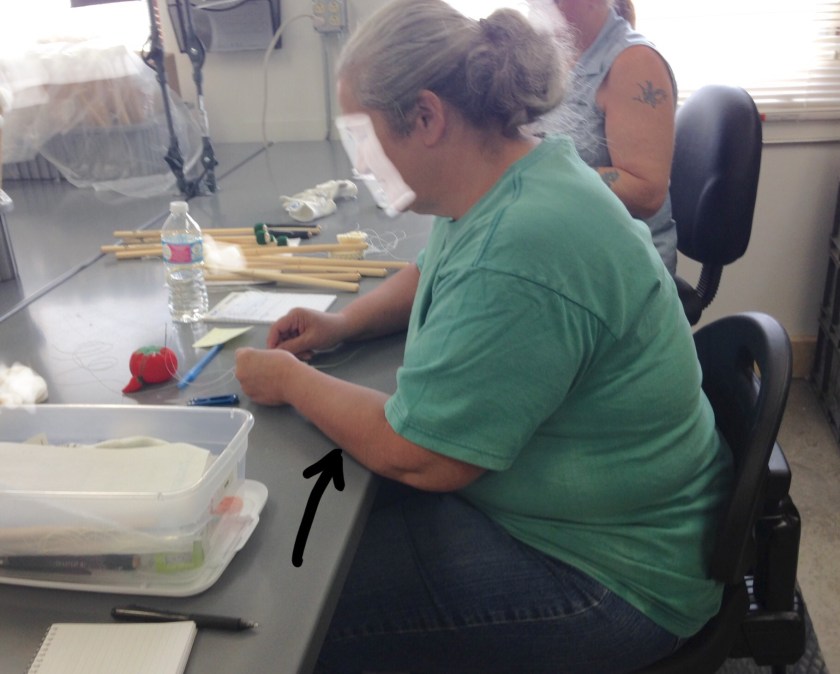
PINCH… is even worse than grip for tendon and carpal tunnel risks.  Simply using padded grip-pinch surfaces ease stresses to carpal tunnel, tendon, and thumb CMC joint structures

IMG_1135

Small grip diameter (esp this heavy)… use a padded crutch grip in hand to encircle bucket handle for wider, softer grip.  Also, replace 5 gal buckets with 2 gal buckets to lighten load… and store them at safe lifting heights.. as mentioned next, below4B7D7DD5-6569-4E01-ACB5-243D2A8FA68E

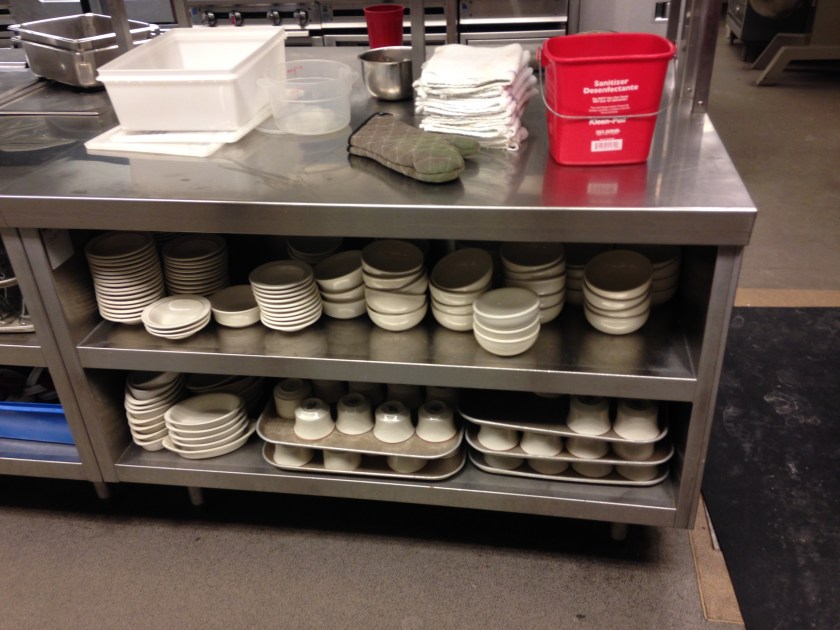
Store your stuff to minimize handling risks… stuff you need frequently or heavy items should be stored at waist height… while stuff you need less often is stored progressively higher or lower.  Here, the coffee cups are needed often, but stored very low, risking repetitive lower back forward bending strain for kitchen staff, especially when lifting a full tray of them, as shown hereC14D5C03-7AF0-464D-912F-520C5F55902A

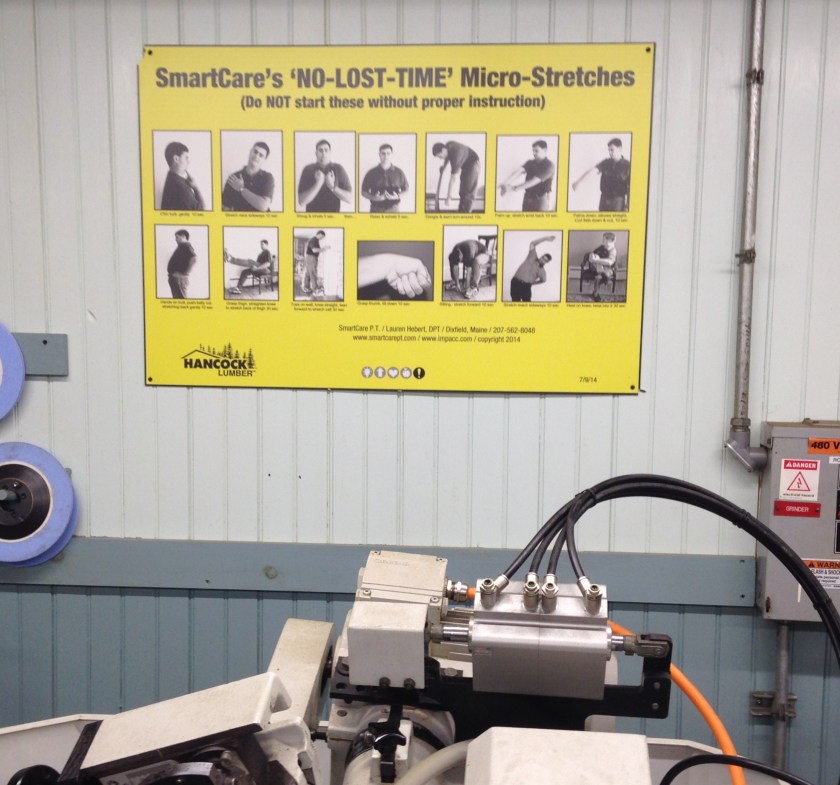
CUSTOMIZED MICRO-STRETCHING set up by a PT to match the demands of each work area… very effective, but on;y if employees are effectively trained in what-how-why-when…4DCBCAA5-9804-4B60-B3CF-6D2F5B3C3FC8

ARMS SUPPORTED BY WORK SURFACE… Position work and worker to gain some upper extremity support on the work surface, to reduce neck-shoulder posture “holding” demands.  Important re. Thoracic outlet inputs to UE MSD73B05A46-5756-419D-9A63-A9F738AEF835

PERFECT LIFTING EVERY TIME… Get close to load; preposition feet to minimize twisting, tuck chin in and push chestbout somehatntomcreate mild inward swayback arch in lower back as you bend knee… pre-position feet to reduce arc twisted with load… then put the load back down the same way..AFE6A072-AE0F-4A5C-8CBF-702833D87F74

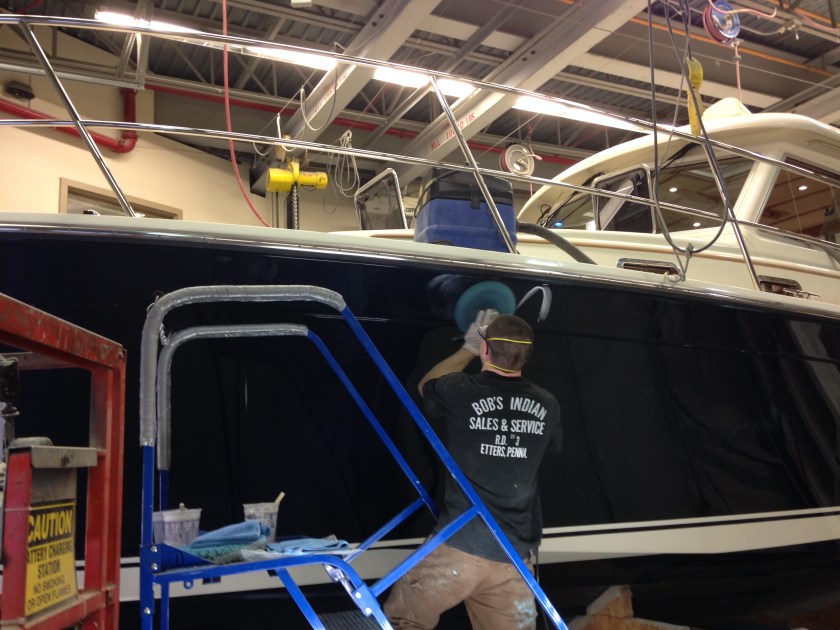
POSITIONING… Platforms to elevate worker can reduce height of shoulder reach elevation.  Workers in this example should take time to position these platforms or ladders to minimize reach-elevation (supervisor input to make sure it happens). Also frequently CHANGE position to work with arms, to vary posture stresses at shoulders.

IMG_0575

Our Secret Weapons for MSD

Our most critical VALUE… is we teach workplaces several new, unique, effective approaches to MSD elimination.  Many traditional approaches to ‘ergonomics’ and prevention just DO NOT WORK.

There are pioneering new understandings about MSD of the neck-arm and lower back that we exploit to re-define the best practices for preventing and reversing MSD.  We are the cutting edge of this effort !

>  Repetitive motion is NOT the issue.  Repetitive motion, by itself, does not generally cause MSD.  Tendinitis is not the result of friction wear damage.  MSD is a (key!) NUTRIENT PATHWAY DISORDER.  Hardworking musculoskeletal structures consume fuel (sugars, oxygen, nutrients) delivered by blood supply.  Tissues burn the fuel, producing acid wastes.  Circulation absorbs and removes these wastes.  BUT muscle contraction, tendon tension, joint compression all create pressures that exceed perfusion pressures that feed and cleanse working tissues.  This causes metabolic wastes to become trapped in tissues… acid irritation… pain… inflammation!  It is a blood supply issue.  Prevention… restore blood supply to working tissues throughout the work day.  We have several tactics for that.

>  Posture Loading is the big risk.  Sustained sitting, sustained standing, forward head slouching, sustained grip, sustained shoulder elevation.  Also: PERFECT POSTURE IS BAD FOR YOU… if you sustain it too long.  Too many ‘ergonomists’ will dictate a chair setup and computer setup that places person in ‘perfect’ posture, only to result in pain.  If posture is perfect, there is still weight-bearing compression to joints and disc, plus supportive muscle contraction and tendon tension to maintain that posture.  The body needs movement to cyclically load-unload tissues to ‘sponge’ them to enable them to mechanically flush with fluids. Posture VARIETY is far more important and healthy than ‘perfect’ posture.  I don’t care how someone sets up their chair, as long as the slightly change the height (by only 2″) or tilt every half hour, to re-distribute loading to other structures.  Switching between sit versus stand works great!  Switch between computer mouse versus trackball hourly to re-distribute loading between digit flexors versus extensors, for variety of loading.  Flip keyboard legs in versus out hourly to slightly alter wrist loading.  So simple, cheap, effective.

>  Forward head posture creates a degree of thoracic outlet-inlet loading... not by much but enough to compress low-pressure lymphatics and veins proximally, allowing fluid backup and stasis distally and within the brachial plexus (altered neurodynamics).  This risks neurovascular entrapments such at carpal tunnel, radial tunnel, cubital tunnel, Guyon’s canal, pronator… complicating or mimicing other MSD’s such as tennis elbow, golfer’s elbow, deQuervains.  FHP is a major risk factor for a variety of UE MSD’s.  Teaching and motivating people to “be an inch taller” (my favorite PT advice) greatly reduces MSD risks.

> Upper extremity support on desk surface… seemingly simple and often overlooked, or even discouraged by outdated ergonomists… adds to forward head posture risks.  The upper extremities ‘hang’ from the neck by the neck muscles, adding posture load.  Resting arms on padded desk surface greatly reduces this.  Gel pad in front of keyboard and mouse allows such support and reduces neck and thoracic outlet loading.

>  Lifting is NOT the primary cause of low back injury.  Injury usually occurs during lifting to a back that is already compromised and worn. it is a gradual disease process, painless until a final load overcomes what remains of the back structures.  Bending; sitting; tight hamstrings; age changes to disc, then joints, then muscles all gradually wear the structures… until a light load collapses something.  Posture variety, task variety, micro-stretches that address disc changes and hamstring mechanics can reverse many of these risks, as can after work recovery stretches that reverse degenerative changes in the spine.  Lifting ergonomics (wt, frequency, how low, how high, how far away, lift with twist, grip efficiency) are important… but… worker behavior (body mechanics techniques) are equally important.

>  BEST PREVENTION TACTICS… 1. work task variety by rotating between two or more job tasks often (see mouse and keyboard tricks mentions above)… 2. frequently switching between sitting versus standing (check out the Vari Desk for computer desks)… 3. hourly Micro-Stretches to certain key muscle-tendon units.  Yes, this DOES WORK, especially where ergonomics is stressful but cannot be fixed.  See our separate essay on this elsewhere on this site.  Also, modifications of these done after work will facilitate much better recovery and repair after work… and reverse much of the age changes that accompany daily wear damage.

>  None of these work unless people are professionally educated by an expert on this topic, who can motivate people to accept THEIR responsibility to take care the the ONLY body they have with which to feed their family and live their life.

varidesk

CORNERDESK

ScreenShotLHLift

MSD prevention guide Ebook


Build Your Prevention Practice

Guiding Physical Therapists to build a successful Workplace MSD Prevention Consulting Practice

Dr. Lauren Hebert, DPT, OCS, is one of America’s most experienced Physical Therapists providing musculo-skeletal disorders (MSD) prevention programs… targeting work-related low back and neck-arm overuse problems… providing MSD prevention and ergonomics consulting to more than 600 workplaces, in every industry sector, since 1982… with excellent outcomes, reducing MSD Worker Comp claims and costs.

** This format of PT consulting practice has great outcomes, saving enormous human suffering and costs… while providing the Physical Therapist with excellent consulting income ($300/hr consulting fees)… direct pay, outside of insurance billing ripoffs.   This practice specialty is a safe haven from the collapse of insurance-based clinical practice.  It certainly saved our practice.

Traditional insurance-payment based clinical practice is doomed in today’s hostile healthcare economy.  PTs must re-define their careers, re-define their roles in society.  Teaching workplaces how to avoid MSD claims, teaching employees how to avoid MSD problems, teaching aging workers how to stop and reverse musculo-skeletal aging changes… offers a great opportunity for PT’s to succeed.

Providing MSD SCHOOL… OFFICE ERGO SCHOOL… AGING WORKER SCHOOL employee self-care training programs can greatly reduce Worker Comp claims and costs… and empower-motivate employees to take much better care of themselves.  These programs are very well received by our client workplaces.

Building a Work Injury Prevention & Ergonomics Practice

Helping workplaces and their people avoid musculoskeletal disorders (MSD)…and associated Worker Comp claims and costs.

** I have been doing this since 1982 at more than 600 workplaces in every type of work setting imaginable.   I have trained more than 100,000 workers how to reduce MSD and restore the working-aging musculoskeletal system.  I have a LOT of experience that I love to share with other PTs looking to get into this type of work.

And this is a critical practice specialty in today’s HOSTILE HEALTHCARE ECONOMY.  Clinical PT patient care billed to insurances is a DOOMED business model !  That has finally become obvious.  But going to workplaces to teach them how to reduce MSD and its Worker Comp costs is a HUGE untapped market opportunity for PTs.  What profession is better trained that PT on musculoskeletal function and dysfunction?  None.  We can teach people how to avoid MSD and reverse musculoskeletal aging.

We are now forced to re-define PT !

This is a consulting business that earns $300/hr, direct pay, not third party insurance billing ripoff… and workplaces typically see 50-60-70% declines in MSD claims and costs.  The client pool is enormous.  The need is great.  The outcomes are great.

I provide client workplaces (1) a PT-based MSD and ergonomics risk assessment of the workplace… (2) manager-supervisor seminar on their risks and how to correct them… (3) employee training on how to avoid MSD through posture risk control, personal ergonomics skills, protective biomechanics, and self-care of the working & aging body.

Specific programs include our McKenzie-based (somewhat) Back School; our Neck-Arm MSD School; Computer Ergonomics School; and (now very much in demand) Aging Worker School.

Employees are trained on-site at the workplace in classroom setup. Programs are professionally presented on PowerPoint, with supportive employee handouts. Each class is two hours. (if employer wants a shorter session, we refuse, because the employees will miss out on critical information. That reduces program effectiveness… and we refuse to provide ineffective services.)

What we are doing is… simply… ‘patient education.’  But instead of educating one patient at a time in the clinic, we are educating classrooms of employees… using basically the same presentation content. “Here is how you develop tennis elbow… and here’s how you avoid it.” We teach workers to become experts on their working musculoskeletal system. They hunger for this education because they work hard and go home sore… and are steadily getting more sore as the years pass. They don’t want to be sore. They want to earn a living and enjoy life after work. We give them that capability.

THE BIGGEST CHALLENGE is effectively MARTKETING to client workplaces. PTs are terrible at marketing.  We have a structured protocol for marketing I will share on this site. This is critical to success.

The “product line”… the “Initial Eval” is a protocol for evaluating work tasks (MSD Ergo Risks Analysis) to identify the various (and obvious) risk factors for neck dysfunctions, TOC, shoulder dysfunctions, overuse disorders of the elbow-wrist-hand, and the various low back dysfunctions and derangements.  These are easy to spot.  We then have a list of prevention tactics from which to suggest to the workplace.  This is written up in a report.

We then offer an on-site seminar for managers and supervisors on MSD and how to eliminate it from the workplace.  We then provide (and this is the guts if our program) the employee 2-hr MSD School… which combines a back school and a Neck-Arm Overuse School. Office people get the Office Ergonomics School version of that. A growing number of workplaces also hire us to provide our AGING WORKER School… simply our original MSD School modified to directly address the aging musculoskeletal system.

Employees learn how they age, how they develop MSD, and the various tactics available to them to stop and reverse these issues (personal ergonomics skills, self-care tactics, and more… job task rotation, sit-stand options, workplace micro-stretching, after-work recovery stretches).

What is most unique is our newest updates to MSD patho-mechanics and prevention tactics.  For instance… repetitive motion is NOT they primary cause of upper extremity MSD. Rather, it is the result of STATIC POSTURE, blocking nutrient pathway, forcing anaerobic metabolism, increasing metabolic wastes that are not cleared out because of circulation being blocked by static muscle contraction, tendon tension, and joint compression. MSD is a STATIC POSTURE DISORDER.

We also emphasize the role of forward head posture causing neurovascular compression (even mildly) at thoracic outlet, increasing MSD risks distally. We then emphasize that “perfect posture is bad for you” if you sustain it in an unchanging manner. Posture variety is far more important than proper posture.

We then recommend simply low-cost or no-cost ergonomics tactics; work task rotation, sit-to-stand rotations, workplace micros-stretching (yes, it DOES work… if you do it right !), and after-work recovery stretches.

START-UP TACTICS… 1.  It is easiest to start focusing just on Office Ergonomics.  You can easily build a protocol for ergonomics risk assessment for office work (several tools you can use are located in various pages on this blog), and build an employee education presentation on personal ergonomics tips and self-care tactics.  This is simple, easy, a bit generic (only so many ways to sit buttocks on a chair at a desk to type on keyboard, right?) but highly effective at reducing MSD risks, pain issues, posture dysfunctions, amd reconditioning from sitting.  And virtually every workplace has office employees.  This is a great prevention sub-specialty to offer that gets you in the door for even more consulting once you have addresses]d office ergo risks.  AND 2. Focus on smaller workplaces of 20-200 employees.  It is so jch easier to get into these workplaces to provide paying work.

I TRULY WANT TO HELP OTHER SUCCEED AT THIS.  I am currently easing into retirement and wish to have my experience facilitate the success of others.  I can help PT’s build and succeed in the business of Workplace MSD prevention &ergonomics.   This is an easy specialty to become very good at.  The stratup process is the big challenge… and I love helping PTs succeed at that

I do NOT charge for offering advice.  I simply want to see this specialty grow.  Some PTs  come to Maine to witness me providing these program at my client workplaces… as a tutorial experience.

Go to http://www.impacc.com to see how I describe this service to my client workplaces, then see our clinic web site to see how we integrate this into clinic practice  at www.smartcarept.com to see how I structure my consulting practice around the clinc practice (info for PTs, info for workplaces, NLT)

** A SUGGESTION… Some are asking how best to replicate-emulate-copy my Workplace MSD Prevention & Ergonomics Consulting Practice.  Why re-invent the wheel? You can invest many, many hours building your version of Workplace MSD School, Office Ergonomics School, Aging Worker School, Back School, Neck-Arm CTD School on PowerPoint, author up your presentation content, develop marketing materials, assemble supportive evidence, etc… then try to sell this to workplace clients, but unable to demonstrate to them any outcomes.

OR… you can simply acquire my entire system already fully developed and use my outcomes as a selling point to gain paying client workplaces.

I have my entire consulting practice stored on CD or thumbdrive… to allow any other PT to duplicate my practice format for themselves.

My consulting practice “kit” is all set for you to run with, once you learn its content (easy). The challenge is to effectively market this to potential client workplaces. Most PTs are NOT very good at that. But I am. After doing this since 1982, I have successfully overcome every client objection, barrier, resistance you can think of. You can use my web site to allow your client workplaces to examine the preview and supportive evidence. Since you a using my program, you can use my track record of outcomes (encompassing hundreds of workplaces over many years).

If you paid $600 for this “kit”, you recover that cost with one-half day of providing billed services to a client workplace. How often does that happen with a ROI ?

Our consulting practice “kit”…_PracticeStartupKit

Want more info… email me at Lhebertpt@prexar.com

MARKETING your Prevention Services

Our best marketing secrets!

THE MOST CRITICAL FACTOR TO YOUR SUCCESS:

Providing MSD prevention services is relatively easy….HOWEVER…. getting a workplace to realize they need you is not at all easy!    MARKETING is the most critical skill you need to succeed in this business.

Let me steal this from a FB group that I frequent:

“ There is no relationship between being good at what you do and getting paid for what you do…. There is a direct relationship between being able to communicate (aka sell) the value of what you do and how much you will get paid for what you do.”
Anthony Maritano

MARKETING these services to industry will be your greatest challenge.  It will be challenging and often frustrating, as client workplace decision-makers (the individual who decides whether to hire you) often do not have a clear, accurate understanding of their problem.  Their view is often clouded by misconceptions about MSD and distorted by outdated assumptions.

When we compare those therapists who succeed with our programs versus those who do not succeed, we see a sharp trend… the ability, confidence, and effort at MARKETING.  We cannot emphasize this enough!

Many PT’s complain they do not want to do marketing.  But you are already a marketing professional.  You market to MDs for patients.  You market to insurers to pay for your services.  You market the public about your profession at every opportunity.  Most importantly, every day your patient treatment is an ongoing marketing process whereby you market to your patients to do their exercises and control their ADL risks.  This is marketing you already do every day.

Patients are easy to market because their problem is clear to them and it is easy for them to understand what you can do for them.  And it is easy to market to them to do their exercises. Physicians and other referral sources such as insurers or case managers have a degree of understanding as to their needs and how you may help them meet those needs.  This marketing is relatively easy.

But the workplace presents to you a different challenge, as they may not have a clear understanding of what is wrong or how you can fix it.  And you, the PT, may not have a clear understanding about this client workplace and what they perceive to be their needs.  We try to answer that here…

> “Where to start… How do I find client workplaces?”

First, where do your patients work? This is a great source of marketing intelligence for you. You know what MSD problems that workplaces is having. Patients can educate you further on what are the problems; why injuries; how company views and handles MSD claims; workplace policies, politics, attitudes; WHO is the best contact person; what is their attitude-viewpoint on MSD; how best to approach the company. Great essential insider info !

Then make a call to that key person: “We have been treating your people with MSD. Would you be interested in hearing about a highly experienced program that has greatly reduced MSD for several hundred workplaces around the US? We have acquired this program and found it to be quite simple and straightforward and shows great results.

< Focus on SMALLER workplaces!

The richest supply of clients actually resides with smaller employers.  We concentrate on employers with 50 to 500 employees, with the most business coming from 30-150 employees.  Smaller workplaces are easier to get into to make a proposal, quicker to agree to give our program a try, and most committed to implementing our suggestions, yielding the best outcomes.

It is far better business to work ten small client companies over a six month period, than to work one big company during that period.  This is especially true when you reserve three months of work for a large employer, only to have them cancel the work a week or a day before you were scheduled to start work.  Then you are stuck with an empty schedule, unable to fill it under such short notice.  That can be a business disaster.  Been there and done that.  We now avoid filling our schedule with one big client.  Rather, we scatter their work among work scheduled with other clients, to preserve our cash flow in the event of a last-minute cancellation.  Diversify your work!

Every workplace has desk-computer jobs.  These have a high risk of MSD. They all have the same risks, which are so easy to correct.  It is a rather generic process:  everyone sits staring at the screen as hands enter data.  BUT companies have been given INCORRECT or OUTDATED ergonomics advice.  When a company hears that, they become very interested in what you have to offer to correct that.

This is a good startup path because teaching them updated prevention tactics is quite easy in an office setting.  We will post an essay on new office ergonomics & MSD prevention tactics on this site.  Our MSD School Kit has a dedicated powerpoint presentation (Office Ergo School) that you can bring to these settings.

CORNERDESKComputerSetup2

“But I have a BIG company in town that will give me lots of work!

Wait! Be careful! Many therapists make this common mistake (we did, too). It is best to focus mostly on smaller workplaces with 25-500 employees. This gives us a steady flow of well-paying work. This is far more successful and productive than trying to sign up a big company. Why? Smaller companies are much easier to get in for a presentation. It is easy for you get direct access to the top decision-makers. They are much quicker to make a decision, then much quicker to execute the decision to bring you in for work.

Big companies are a very different story. If you have a successful meeting with a key person at a very large company, and they say “yes let’s do this,” how long will it take for you to actually end up on-site doing billable work? Our extensive experience says 1-3 YRS! And this is where everyone there is saying “yes, let’s do this.” Frustrating.

This is due to their BUREAUCRACY: a parade of committees that have to hear about this and the several key people who need to sign off on it. You often end up making many presentations to many groups, trying to get them signed up for services. Then, worse yet, if they actually sign off and you schedule actual work, completely tying up your work schedule for weeks or months, only to have some key manager change their mind and cancel-postpone at the last minute… and you end up with lost work and lost income and en empty work schedule that hurts you income flow. We have been burned by this several times!

Another problem arises when they ask for a budget proposal detailing costs. The dollar figure is often large enough to trigger a public request for competing proposals.  Do NOT present them with a full-facility comprehensive budget proposal quoting a 5-figure price tag.  You will be done at that point.  Insist that we proceed one department at a time, to control their costs.  See below re. proposing a Pilot Project.

Propose a Pilot Project… The key to working with large companies is in little bites: proceed only one small project at a time. The KEY is to propose a PILOT PROJECT. Have them pick out one small but difficult department with lots of MSD issues for you to demonstrate your program. They will see this a tough challenge for you to attack, but it is actually very easy to do good work in a very messed up work area! This allows easy logistics for them to schedule and execute. It proposes a small $$ budget that is easy to approve. And you are committed to a smaller number of work days, freeing your schedule for other workplace clients. (It is important to DIVERSIFY your client base, so that if one cancels work for whatever internal reason, you still have scheduled work to maintain business income flow.

For a large company we may schedule only 1-2 days per week, usually every other week for on-site work, especially if we have other workplaces ready for our services.  It protects your income when you spread your work over several companies over several weeks-months (in case one cancels or postpones scheduled work).

“How do I get in front of the right decision-maker?”

Who do I market to at a potential client workplace?  Different companies delegate decision-making authority among various people on this issue, so the answer to the question will vary.  But there will be a minimum of two parties to consider… your primary or opening contact person at the company… and, later, the person who actually has the budget authority to hire you.

Your opening contact person may be with the human resources manager, safety manager, occupational health nurse, or even a specific department head.   It will vary according to facility size and command structure.  We target any company with more than 50 employees.  The smaller the company, the higher up the command ladder will be your contact person. You may even deal directly with the plant manager or company owner at a smaller site of 50-150 employees.

Somewhat larger sites (200 – 400 employees) may allow these decisions to come from the human resource manager, safety manager or occupational health nurse.  Much larger companies may allow decisions to come from the human resource manager, safety manager, occupational health nurse, worker comp loss control manager or even individual department heads acting as your opening contact person.  Many larger companies (1000+) may be best marketed a department at a time.  This is about the only way to get into a big plant.

Your opening contact person is of these people listed above who initially brings you into the facility. This person’s role is to initially determine if you may be of value to the company.  They are the initial screening of you and what you offer.  If this person decides you are of value to the company, that does not mean they can actually hire you, as they may not have budget authority.

The role of the contact person is to put you in from of the person with budget authority.  It should be your objective to enable the contact person to get you in front of the person with budget authority.  Only then can a deal be struck.

And there may be intermediate steps between the contact person and the person with budget authority, such as a safety committee or ergonomics committee or even union leadership.

>  “How to make an effective Marketing Presentation ??”   (critical)

There are several steps.  First: EXPLORATION. Learn their perceptions of their MSD problems. Do they see them as mostly faking or lazy excuses; or work is very hard or repetitive; or we are stuck with these as unavoidable; or this is genuine employee health and safety hazard and we want to do something about it; or we are suffering the effects of an aging workforce. Make contact with a person there who is on the front line of the MS problem and ask them why they think they have an MSD problem… and just LISTEN… actively LISTEN. Ask questions that lead them to spill their guts on their MSDs. We come tight out and ask the safety manager, ”Tell us about your MSD problems; why you have MSD; what you have tried to do to control it; what has worked; what has not worked and why.” We also ask the obvious question, “What is your objective on this?” Sounds obvious, but it helps commit them to what you eventually propose, if you can make it fit those objectives. We do this exploration prior to making our presentation. It also allows you to anticipate what objections they may make to your eventual proposal, so you pre-emptively avoid them.

Next: We now use THEIR impressions and experiences to PRESENT… to describe the VALUE of what you offer to meet their objectives. “Hello. I am Dr. Lauren Hebert. I am a Physical Therapist specializing in teaching people in the workplace how to avoid musculo-skeletal pain problems. I am Board Certified in Orthopedics. I have been doing this for 42 years; half that time treating people with these problems; the other half in several hundred workplace studying these problems to determine exactly how workers develop rotator cuff, tennis elbow, tendinitis, carpal tunnel, and each of the six categories of back problems. We have developed a structured program that teaches everyone in the workplace how to avoid MSD injuries, claims, and costs. We have delivered this program to more than 600 workplaces across the US. We have tracked OSHA records at most of the workplaces to measure results, which show an average 70% reduction in lost work days following our program. We go to the workplace to examine MSD issues and look at jobs so we can customize our program to address your issues. We teach managers and supervisors what they must do to reduce MSD risks. We then teach employees to become experts at reducing their MSD risks, personal ergonomics skills, perfect body mechanics, and (most importantly) how to reverse the damage of work and aging changes. And this damage is, indeed, reversible.   We have written a small Pilot Project for your most difficult work area so that you can see for yourself how we do what we do and what effects it can have here.”

Try to focus primarily on describing the EFFECT (the VALUE) of what you do… NOT the specific features or details of how we do this. That invites objections and debate. Example: don’t focus much about stretching exercises; too controversial. But they will likely ask, so we slip in … “ we teach employees personal ergonomics skills, risk time exposure reduction, and how to reverse the wear damage that builds up day after day.” That will invite the question. We then answer, “we teach employees how to select certain key TEN SECOND MICRO-STRETCHES that address muscles and tendons and joints that are being loaded by work tasks. There is one micro-stretch for tennis elbow, another for golfer’s elbow, another for disc bulging, two for neck strain. These are tiny brief stretches easily slipped into the workday without getting in the way of production, plus a few we recommend after work to reverse the aging damage of the day. Our experience has been that employees really, really appreciate these, especially those who you would think would really resist this idea. Notice how I describe these in a manner that reverses any potential objections your client workplace may have to this idea.

>  Do NOT focus how much you CHARGE for this. Please:  COST is NOT an issue !!

So many therapists worry about what they may be charging for this. They feel obligated to negotiate costs.  This can kill your business. You are not dealing with insurance company network rip-off fee schedules. In the non-healthcare business world, price is NOT the issue to consider. Rather, the real issue is VALUE. How much money is the client going to save? We offer a service with a track record drastic reductions in MSD claims, lost days, and Worker Comp costs, as well as indirect cost savings from improved production and employee health.

The purpose of your marketing is to illustrate the VALUE of what you offer (not debate the cost). If you are effective at pointing out the potential effect on reducing Worker Comp costs, claims, lost work day, production, employee health and morale… then there is no need to discuss costs.  If you are dickering over price, you have not succeeded at your marketing, or you are talking with someone without budget authority to hire you.

We do not discuss costs. When a client asks, we tell them we will provide them a “Budget Proposal” for a “Pilot Project.”  This presents a small cost because it focuses on a small demonstration project.  We never submit a proposal for a large facility-wide project, only one department at a time.

We base our fees on $300/hr for on-site services, plus $75/hr for travel time to and from client workplace. No, we do NOT negotiate that rate. I estimate less than ONE percent of clients have ever offered an objection to price, last one was back in the 1990’s. Do NOT get hung up on your price!  Price is NOT the issue that determines whether the client hires you. What is your service WORTH?! If you prevent only 1-2-3 MSD claims, the client workplace breaks even on the investment… and we get much better results than that.

Clients understand that this is a structured, effective, respected, PROFESSIONAL program and, therefore, has an appropriate cost for them to access its value. If a client asks about negotiating price, we answer, “we structure our fees based on the value of the program, and we try to stay consistent among our clients, to be fair to them all.” It is kind of a “take it or leave it” approach, subtly presented. If they have tight budget limits, we are willing to do the program a department at a time spread over months to fit their budget structure. No, we do NOT do “train the trainer” or “video-based training.”  We do not provide services that are ineffective, and these are ineffective (plus it rips-off your program, and violates my copyright).

Yes, a local chiropractor may offer to do back schools for free… but what is that worth? What is that DC’s track record for prevention? Are they motivated to reduce back claims, or merely to get employees to come to their office for endless care?  We offer a far more experienced and proven program that goes way beyond a simple class on proper lifting and the value of manipulations.

One tactic that almost always works is to offer a demonsration class, perhaps for office staff or for supervisors or union leadership… whereby if they like what they see, you will simply roll the cost of that session into their program.  If they dislike it, there is no charge.  Just aware that they maylan to learn what they can from you in the class, then try to run with a program without you.  But what they actually learn is they really really need you to do is program… so don’t worry about it.

This is a seminar we provide for prospective companies to hear about what we do:

IMG_1159

Contact Lauren at Lhebertpt@prexar.com

See web site for workplaces describing our service http://www.impacc.com

Our clinic web site shows how we integrate this into clinic practice http://www.smartcarept.com

Two of our Marketing Guides we include in our program package for PTs to build a Prevention Practice…
MarketingGuide!
KillerMarketingTactics

Great Resources & Downloads!

Reverse musculo-skeletal AGING  (2021 update) : AgeLess

Neck-Arm Tendinitis & self-care guide:  Neck-Arm

Low Back self-care guide:  LOW.BACK

Headache-TMJ-Neck pain self-care manual:  HA.TMJ.NECK 

Office Ergonomics manual officeErgoEbook

MSD pathomechanics references.. MSDpathomechan&amp;refs

MSD prevention guide.. ErgoTeamEbook

My Self-study course on how to create this consulting practice for yourself; course info: SelfStudyInfo

** Lauren’s email… Lhebertpt@prexar.com

Web site for workplaces to preview PT prevention services  www.impacc.com

Another Self-study course “The Injured Worker” from APTA Orthopaedic Section at….Visit their web site to learn more about the course and to register; course 24.1

better link here..

http://orthoptlearn.org/doi/book/10.17832/isc.2014.24.1?code=ortho-site#/doi/book/10.17832/isc.2014.24.1

———————————-

How to Build Your Consulting Practice?   Simply “copy” mine !

Why try to re-invent the wheel? You can invest many many hours building your version of Workplace MSD School, Office Ergonomics School, Aging Worker School, Back School, Neck-Arm CTD School on PowerPoint, author up your presentation content, develop marketing materials, assemble supportive evidence, etc… then try to sell this to workplace clients, but unable to demonstrate to them any outcomes.

OR… you can simply acquire my entire system already fully developed and use my outcomes as a selling point to gain paying client workplaces.
I have my entire consulting practice stored on CD or thumbdrive… to allow any other PT to duplicate my practice format for themselves. _PracticeStartupKit

It is worthwhile to consider this practice format for yourself. It is fully cash-based, no insurance billing ripoffs, $300/hr onsite consulting rate, virtually unlimited client base. It is quite easy to do. You can easily manage your schedule, full-time or part-time. No office or clinic overhead costs. All work is done at the client workplace. Setup and ongoing operating costs are truly tiny.

My consulting practice “kit” is all set for you to run with, once you learn its content (easy). The challenge is to effectively market this to potential client workplaces. Most PTs are NOT very good at that. But I am. After doing this since 1982, I have successfully overcome every client objection, barrier, resistance you can think of. You can use my web site to allow your client workplaces to examine the preview and supportive evidence. Since you a using my program, you can use my track record of outcomes (encompassing hundreds of workplaces over many years).

If you paid $600 for this “kit”, you recover that cost with one-half day of providing billed services to a client workplace. How often does that happen with a ROI ?

FMI: email me at Lhebertpt@prexar.com

CRITICAL ARTICLES LINKS!!

Excellent on eccentric exercises for tendinopathy:
https://academic.oup.com/rheumatology/article-lookup/doi/10.1093/rheumatology/ken337

Managing LB Pain Risks (2) :
https://drburchphysicaltherapy.com/2017/05/30/the-next-path-for-pain-neuroscience-education/

http://www.scottgraypt.com/book-review-world-hurt/

Critical factors re Subacromial Impingement Sx (posture, etc)
http://www.sciencedirect.com/science/article/pii/S2468781216308347

Non-surgery Rx for Rotator Cuff Tears:
https://www.ncbi.nlm.nih.gov/pmc/articles/PMC4827371/

Neuromotor changes in tendinosis…
https://www.ncbi.nlm.nih.gov/pmc/articles/PMC4553058/

The self-study The Injured Worker (APTA Ortho Section)
http://orthoptlearn.org/doi/book/10.17832/isc.2014.24.1

An interesting(?) MSD treatment protocol summary worksheet for my students treating MSD-injured workers-patients…
NormalizeFunctionMSD
.
.
.
IMG_1255

MSDergoManual

Collection of evidence-literature references, some older but all good..

Lauren’s study.. Ergo&amp;Stretchstudy

Literature lists… Stretch&amp;BSevidence

Plus… LotsofRefsEvidence

Plus… OlderButGreatRefs